The Ohrid Agreement, A Quarter Century of Peace, Coexistence and Progress
Twenty-five years have now passed since the signing of the Ohrid Framework Agreement, a historic document that left a strong mark on the development of our country.
A quarter of a century is a sufficiently long period of time to draw lessons from the past and to make a more objective historical assessment of what happened during those difficult days.
Twenty-five years ago, Macedonia was facing one of the most serious crises in its recent history. Conflict was knocking at the door, while uncertainty, division and fear were present throughout the country. Macedonia could have taken the path of division, confrontation and strong nationalism.
Instead, the country chose another path: the path of agreement, compromise, dialogue and political maturity.
The Ohrid Framework Agreement was not an agreement between winners and losers. It was an agreement that gave the country the opportunity to move forward, to develop and to create a path for future generations.
The greatest achievement twenty-five years ago was that a trajectory and a path forward were established.
The international community and our international partners also played an important role. Macedonia's future is clearly connected with the European Union and NATO, and this reflects not only a political orientation but also the clear Euro-Atlantic orientation of the majority of the citizens of our country.
Today, when we look back at the years that followed the signing of the Agreement, we must also be honest about the fact that there were political structures and political parties that abused the Agreement for their own political and personal interests.
There were politicians who deliberately encouraged ethnic divisions and tensions, using nationalism as a political instrument and exploiting sensitive issues in order to remain in power and pursue personal interests.
Fortunately, those political forces are no longer part of the current Government. Their time of manipulation and abuse should be left behind.
Today, we must not look back at the past in order to revive old divisions. We must look back in order to understand what happened, to learn the necessary lessons and to build a better future.
Coexistence does not mean simply living next to one another. It means living with one another and for one another.
The Ohrid Framework Agreement is a chapter of our history that demonstrates that we have learned how to live together. But it is also an obligation: an obligation to leave to future generations a fairer, more united, stable and prosperous country.
Our task is therefore not only to protect what was achieved through the Ohrid Agreement, but also to develop it further.
We must build a country in which all citizens feel that it is their common state, regardless of whether they are Macedonians, Albanians, Turks, Serbs, Roma, Bosniaks or members of any other community.
The future of Macedonia must be free from ethnic tensions, political manipulation and divisions.
When we speak about the future of Macedonia, we speak about a country that has clearly chosen its direction.
We see our future within the European family, not merely as a political declaration, but because the majority of our citizens, regardless of their ethnic background, support European integration and the country's membership in NATO.
Our vision must therefore be clear and united.
We are building a modern and prosperous country, and our future must be based on economic development, infrastructure, education, healthcare and connectivity.
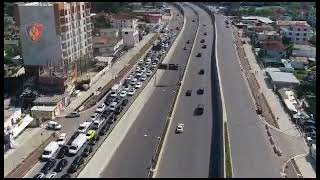
We are investing heavily in infrastructure and in the strategic transport corridors that can transform Macedonia into a true crossroads of the Balkans.
The construction of major road connections is progressing. The Skopje–Blace motorway will strengthen the connection with Kosovo. The Tetovo–Gostivar and Gostivar–Bukoj?ani sections are progressing, while work is continuing on the Ki?evo–Ohrid corridor.
We are also developing the connections toward Bitola and Prilep, Kumanovo and Kriva Palanka, as well as the roads connecting the eastern and southern parts of the country.
Corridor VIII is of particular strategic importance. The railway connection with Bulgaria and the western railway route toward Albania will strengthen Macedonia's position as a regional transport crossroads.
The development of Corridor X and the improvement of railway infrastructure will further connect our country with the region and with Europe.
Our objective is to create a country that is connected, economically strong and capable of providing a better future for all its citizens.
Twenty-five years after Ohrid, we have the opportunity to look at history with greater distance and greater maturity.
The Framework Agreement reminds us that this country belongs equally to all of its citizens, that everyone must be equal and that we must respect one another.
This is something that we must continue to build together.
The responsibility of our generation is to ensure that the conflicts and divisions of the past never again determine the future of our country.
We must love, respect and develop our common state.
The Ohrid Framework Agreement showed that dialogue is stronger than confrontation, compromise is stronger than division, and political maturity is stronger than nationalism.
That is the lesson we must carry forward.
The future belongs to a Macedonia that is united, European, prosperous and at peace with itself.
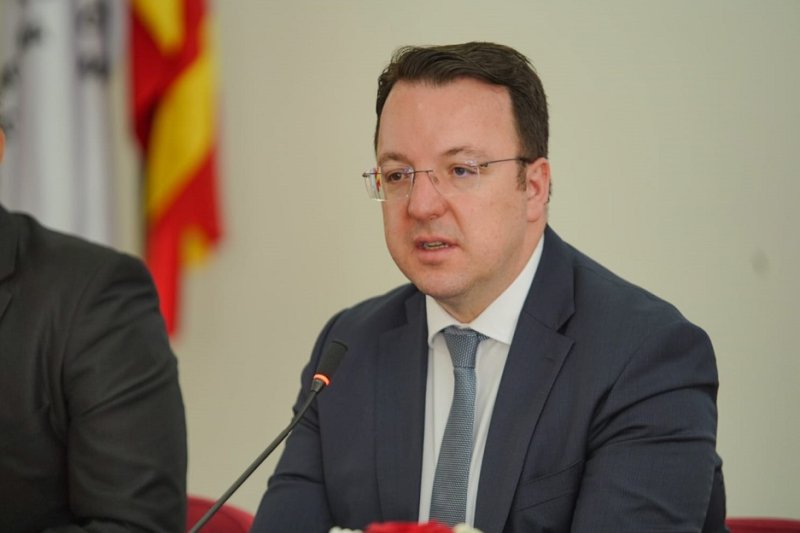
* Remarks of the vice Prime Minister of North Macedonia, Aleksandar Nikolovski on the 25th anniversary of the Ohrid Agreement